

It’s Monday morning in the monitoring and diagnostics (M&D) center, and the dashboard shows hundreds of active alerts. Alarm fatigue in power plant M&D centers is what happens when a monitoring tool raises so many low-value alerts that engineers stop trusting it. Real early warnings get missed along with the noise.
Most of those Monday alerts are noise. One of them might not be. And it’s not a discipline problem, it’s a design problem, and it can be fixed.
Below, we cover what alarm fatigue looks like in equipment health monitoring and how to spot it. Then we walk through the four causes we see most often, and how to cut the noise without losing the alerts that matter.
Key Takeaways
- Alarm fatigue in power plant monitoring happens when engineers receive so many low-value alerts that they start ignoring the monitoring tool, including its real warnings.
- Nuisance alerts usually come from four causes: static thresholds that ignore operating state, bad or missing data, models that weren’t retrained after an outage, and no triage workflow.
- Models that learn normal behavior for each operating state produce fewer false alarms than fixed limits.
- Every equipment monitoring alert resolves to one of three outcomes: a failing instrument, a real equipment issue, or a new operating state.
- The goal isn’t zero alerts. It’s a short list of alerts your team trusts enough to act on.
What Is Alarm Fatigue in Power Plant Monitoring?
Alarm fatigue in power plant monitoring is the gradual loss of trust that happens when engineers see so many low-value alerts that they start ignoring them. Some people call it alert fatigue. The term started in healthcare, where nurses facing constant monitor beeps began tuning them out. The same thing happens in plants. It just looks different.
There are two related problems worth separating. Control room operators deal with alarm floods from the distributed control system (DCS). DCS alarm management is its own discipline with its own standards. This discussion is about the second issue: the equipment health monitoring alerts that M&D engineers review every day. These alerts come from advanced pattern recognition (APR) models and other analytics, and they’re meant to give weeks of warning before a failure.
Most of the noise comes from nuisance alarms. The NIH defines nuisance alarms as notifications that don’t meet the definition of an alarm. Examples include alarms triggered by normal operations and alarms that chatter on and off. In monitoring, a nuisance alert is any alert that doesn’t lead to a decision.
Signs Your Monitoring Program Has Alarm Fatigue
Alarm fatigue creeps in slowly. Run through this list and count how many sound familiar.
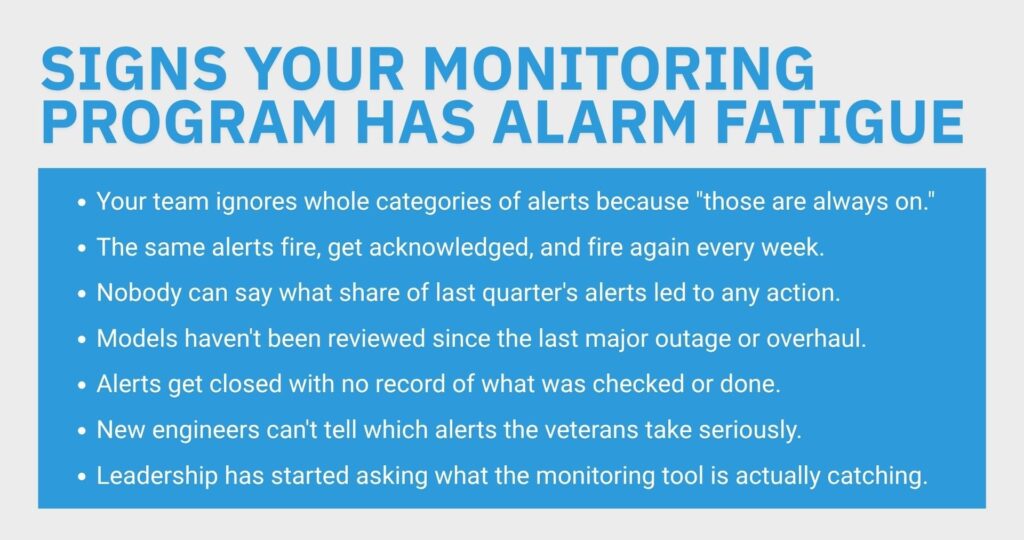
If you counted three or more, the tool is probably training your team to look away.
What Causes Alarm Fatigue in M&D Centers?
1. Static thresholds that ignore operating state
A fixed limit doesn’t know whether the unit is at full load on a hot afternoon or at minimum load on a cold night. Set it tight, and it fires every time conditions change. Set it loose, and it misses slow drift. Either way, engineers learn the limit isn’t telling them much.
2. Bad or missing data
Models learn “normal” from history. When that history includes frozen values, failed sensors, or gaps, the model learns the wrong thing and alerts on perfectly healthy behavior. Cleaning missing and bad historian data before training is one of the most effective ways to prevent noise.
3. Models that were never retrained after an overhaul
Equipment changes after an outage. Clearances, efficiencies, and temperatures settle into a new normal. A model trained on pre-outage data will flag that new normal as abnormal, over and over, until someone retrains it. In many programs, nobody owns that job.
4. No triage workflow
Even good alerts become noise when there’s no process to sort them, assign them, and close them out. If validated alerts don’t turn into tracked work, the same issues keep resurfacing, and nobody can show what the program caught.
How to Fix Alarm Fatigue Without Losing Real Warnings
The fix isn’t to raise every limit until the screen goes quiet. That just hides the problem. The fix is to make each alert more meaningful.
- Model normal behavior by operating state. Instead of one limit, models learn how each tag behaves at different loads and ambient conditions. Normal swings stop triggering alerts.
- Alert by exception. The system raises an alert only when behavior departs from what the model expects, not every time a value moves.
- Calculate thresholds automatically. Alarm limits are set per sensor from the model’s own residuals, instead of being guessed and hand-tuned.
- Retrain after outages. Comparing pre- and post-outage behavior, then updating the model, keeps a new normal from becoming a permanent alert.
- Sort every alert into one of three outcomes. As we explain in how APR alerts work, each alert is a failing instrument, a real equipment issue, or a new operating state. Each one gets a different response.
- Turn validated alerts into cases. A case workflow assigns the alert, attaches the evidence, and tracks it to a work order, so nothing gets acknowledged and forgotten.
Diagnosis helps too. A lot. When an alert arrives with a ranked list of likely causes, engineers know where to look first. Think check engine light versus a mechanic who tells you which part to check.
What a Healthy Alert List Looks Like

A healthy alert list is short enough to review over a cup of coffee. Each alert has a clear reason for being there, a likely cause, and an owner. Instrument problems go to the plant’s instrumentation and controls (I&C) team. Equipment issues become tracked cases. New operating states get folded back into the model.
That’s how we approach it at ECG. Predict-It’s APR module monitors on an exception basis, with alarm limits calculated automatically for each sensor. The Diagnostic Reasoner ranks the probable causes behind an alert. Case Management lets an engineer turn a confirmed anomaly into a tracked case, with trends, documents, and plant correspondence attached, without leaving the workspace.
The payoff goes beyond a cleaner screen. When every catch is documented, the M&D center can show leadership exactly what it found and when.
FAQ
What causes alarm fatigue in power plants?
Alarm fatigue in power plants is usually caused by monitoring tools that raise too many low-value alerts. Fixed thresholds that ignore operating conditions are a big one. Bad or missing training data is another. Models that weren’t updated after an outage and no workflow for closing alerts add to it. Over time, engineers learn to ignore the tool, including its real warnings.
What is the difference between a nuisance alarm and a real alert?
A nuisance alarm fires without leading to any useful decision. It might be triggered by normal operating changes, a failing sensor nobody fixed, or a model that no longer fits the equipment. A real alert points to a meaningful change in equipment behavior. Think of a bearing running hotter than it should for its current load.
How many alerts should an M&D engineer review per day?
There’s no universal number. It depends on fleet size, staffing, and how critical the assets are. A better test is whether the team can review, sort, and act on every alert each day. If alerts regularly go unreviewed or get acknowledged without investigation, the program is producing more than the team can use.
Can retraining APR models reduce false alarms?
Yes. Retraining APR models after outages, overhauls, or equipment changes is one of the most effective ways to cut false alarms. Equipment often settles into a new normal after maintenance. A model still trained on old data keeps flagging it. Updating the model with clean, recent data removes those repeat alerts without hiding real problems.
How is alarm fatigue in power plants different from alarm fatigue in hospitals?
In hospitals, alarm fatigue usually refers to clinical staff tuning out bedside monitors. In power plants, it refers to engineers and operators tuning out equipment alarms and monitoring alerts. The cause is the same: too many alerts that don’t need action. In plant monitoring, better models and triage workflows can reduce the noise.
Fewer Alerts, Better Catches
Alarm fatigue in the M&D center isn’t solved by more alerts or by tougher discipline. It’s solved by alerts worth trusting. That means models that understand operating state, thresholds set from real behavior, retraining after outages, and a workflow that turns validated alerts into tracked work.
If your team has started tuning out its monitoring tool, it’s worth a closer look. See how Predict-It’s APR and Case Management modules handle it, or talk to an engineer about your alert list.