

Advanced pattern recognition (APR) is software that learns how each piece of equipment normally behaves across many sensor tags at once. It then flags when actual readings drift away from what the model expects, even when nothing has crossed an alarm limit.
That matters because most equipment failures don’t arrive out of nowhere. The early signs usually sit in your historian for weeks or months. They hide inside numbers that still look “in range.” Fixed alarm limits can’t see them. APR can. That’s why it has become a core tool for early fault detection in power generation.
Below, we cover how APR works and how it differs from a standard alarm. We also explain what an alert means when it fires, and where APR fits next to condition monitoring and predictive maintenance.
Key Takeaways
- Advanced pattern recognition (APR) models how equipment behaves when it is healthy, using months of historical sensor data across many tags at once.
- APR compares incoming readings to the values its model expects based on current operating conditions. The difference, called the residual, is what triggers an alert.
- APR can flag a developing problem while every individual reading is still below its alarm limit.
- Every APR alert resolves to one of three outcomes: a failing instrument, a real equipment or process issue, or a new operating state.
- APR models are only as good as their training data. Gaps and bad data produce nuisance alerts.
- APR is a form of anomaly detection for equipment health monitoring. It detects changes, flags when maintenance is needed, and gives your team time to plan.
How Does Advanced Pattern Recognition Work?
APR isn’t new or experimental. Power plants have used data-driven models of normal behavior for years. The International Atomic Energy Agency (IAEA) describes the approach as characterizing the normal state of a process from historical data and watching for deviations that indicate incipient failures. In practice, it runs in four steps.
- Training. The model ingests months of normal operating data from the tags you choose: temperatures, pressures, flows, amps, vibration, and so on. This is your equipment’s history on its good days. Aim for a window that spans the seasons. Equipment runs differently in summer than in winter, and a model trained only on winter data may flag a normal hot-weather reading as a problem.
- Model building. The software learns how those tags move together. Bearing temperature rises with load. Exhaust temperature tracks fuel flow and ambient conditions. The model captures dozens of these relationships at once, more than any one person could hold in their head.
- Online monitoring. The model runs continuously. For every scan, it predicts what each tag should read right now, given everything else the unit is doing. It then calculates the residual, which is the actual value minus the predicted value.
- Alert generation. When a residual moves outside its learned control limits, the software raises an alert. The equipment is behaving in a way the model hasn’t seen on a healthy day.
Good APR software also sets those alarm limits for you. Instead of an engineer guessing a threshold for every tag, the limits are calculated automatically for each sensor from its own residual behavior.
When things are normal, the residual sits flat near zero. That flat line is the point. You’re no longer staring at raw values that swing with load all day. You’re looking at the difference between what is happening and what should be happening, and that difference only grows when something changes.
APR vs. Fixed Alarm Limits: A Bearing Temperature Example
A fixed alarm limit asks one question: is this number too high? APR asks a better one. Is it too high for these conditions?
Here’s a simple illustration. The numbers are examples, not data from a real unit. Picture a steam turbine bearing with a high-temperature alarm set at 225°F. On a cool morning at half load, the bearing normally runs around 170°F. Lately it’s been running 190°F under the same conditions. That’s 20 degrees warmer than it should be, and still 35 degrees under the alarm.
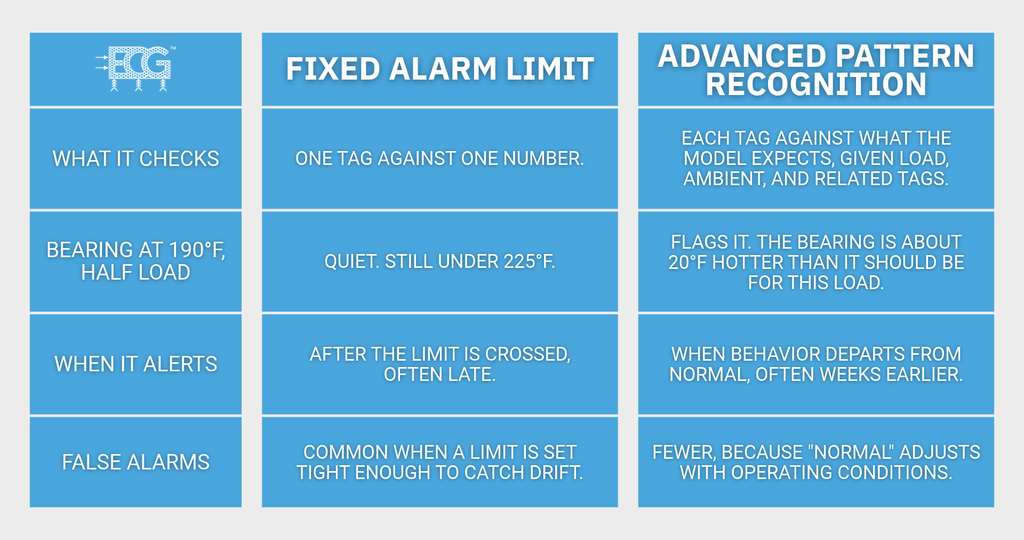
The fixed alarm will catch the problem eventually, probably on a hot afternoon at full load, when there’s no time left to plan. APR catches it while it’s still a line item for the next outage.
What Happens When an APR Alert Fires?
An alert isn’t a diagnosis. It’s a signal that something no longer matches the model. Once an engineer looks into it, every alert resolves to one of three outcomes:
- A failing instrument or connection. A thermocouple drifts or a transmitter loses its signal. The equipment is fine, but the data isn’t. That’s still worth knowing.
- A real equipment or process issue. The bearing really is running hot, the pump really is working harder. This is the catch you’re looking for.
- A new operating state. The unit is running in a way the model wasn’t trained on, like a new firing mode or a change after an outage. The model needs to learn it.
Sorting alerts into these three buckets is where engineering judgment earns its keep. Skip that step, and the alert list fills up with noise until people stop reading it. We cover that problem in depth in our post on alarm fatigue in monitoring and diagnostics (M&D) centers.
Why Good Training Data Makes or Breaks an APR Model
An APR model learns “normal” from your history. If that history has gaps, frozen values, or bad readings, the model learns the wrong thing.
The results are predictable. A model trained on a stretch of bad data may treat a failing sensor as normal. A model with missing data may never learn how the unit behaves at certain loads, so it raises alerts every time the unit goes there. Either way, the team loses trust in the tool.
Good APR software helps clean training data before the model is built. That includes filtering out obvious outliers and filling gaps in historical data in a way the engineer can review and approve. This decides whether your alerts are worth reading.
Where APR Fits: Condition Monitoring, Predictive Maintenance, and Diagnostics
These terms get used interchangeably. They shouldn’t be.
- Condition monitoring is the broad practice of watching equipment health. Vibration routes, oil analysis, thermography, and online monitoring all count.
- Advanced pattern recognition is one way to do condition monitoring, and a form of anomaly detection built for equipment data. APR software runs continuously on data you already collect in your historian, with no new sensors required.
- Predictive maintenance is a maintenance strategy: fix things based on their condition, not the calendar. APR doesn’t do the maintenance. It tells you what’s developing so your team can plan it.
Detection is also only the first step. The next level is diagnosis: taking an alert and ranking the most likely causes, so engineers know where to look first. Think of a check engine light versus a mechanic who says, “It’s probably the oxygen sensor. Check that first.”
One more limit is worth knowing. Most APR models watch steady-state operation. During startups and shutdowns, when equipment is under the most stress, conditions change too fast for a steady-state model to judge. That gap needs its own approach, which we explain in our look at what happens during combustion turbine startups.
Frequently Asked Questions
Is advanced pattern recognition the same as AI or machine learning?
Advanced pattern recognition is a form of machine learning, but it isn’t a black box. APR uses statistical models trained on your own historical data to learn how equipment normally behaves. It then compares live readings to those expectations. Engineers can see exactly which tags drifted and by how much, which makes APR alerts easier to verify and trust than many general-purpose AI tools.
What equipment can APR monitor in a power plant?
APR can monitor almost any equipment with enough sensor data in the historian. Common examples include gas turbines, steam turbines, generators, boiler feed pumps, fans, transformers, and reciprocating engines. It works best on assets with many related tags. Temperatures, pressures, flows, and vibration give the model more relationships to learn during normal operation.
How far in advance can APR detect equipment problems?
APR often flags developing problems weeks to months before failure, though lead time depends on the failure mode and how fast it progresses. A slowly degrading bearing or a fouling heat exchanger can give a long runway. A sudden mechanical break gives very little. The goal is to catch slow drift early enough to plan the repair for a scheduled outage.
What is a residual in APR monitoring?
A residual is the difference between a sensor’s actual reading and the value the APR model predicts it should have. When equipment is healthy, residuals stay close to zero. When a residual grows past its learned control limit, the software raises an alert. Residuals make drift visible even when the raw reading is still within normal alarm limits.
Does APR replace alarms in the control room?
No. APR doesn’t replace control room alarms. Alarms protect equipment and people in real time by tripping or warning when a hard limit is reached. APR works earlier and quieter, usually from an M&D center, flagging slow changes long before an alarm would trip. The two work together: APR buys planning time, and alarms remain the safety net.