


Vibration analysis measures how much rotating equipment vibrates and at what frequencies. That lets engineers trace problems like imbalance, misalignment, looseness, and bearing wear back to their source. A single reading only tells you so much. Context from load, temperature, and operating state tells you whether it matters.
If you’ve just inherited a set of units, vibration data is probably some of the most useful information you have. It’s also some of the easiest to misread. This guide covers the basics: what vibration analysis measures, what 1x and 2x mean, and the signatures behind the most common faults. Then it covers what a single number can’t tell you, and how pattern recognition fills that gap.
Key Takeaways
- Vibration analysis looks at two things: amplitude (how much a machine moves) and frequency (how often it moves, usually compared to running speed).
- 1x vibration happens once per shaft revolution and often points to imbalance. Strong 2x vibration, twice per revolution, often points to misalignment.
- Mechanical looseness, rolling element bearing defects, and sleeve bearing problems each leave a recognizable pattern in the vibration spectrum.
- There is no universal “safe” vibration level. The U.S. Department of Energy notes that absolute vibration limits are impossible to establish.
- The same vibration reading can be normal at one load and a warning at another. Context from load, bearing temperature, and lube oil data turns a number into a decision.
What Does Vibration Analysis Measure?
Vibration analysis measures two things: amplitude, or how much a machine moves, and frequency, or how often that motion repeats. Every rotating machine vibrates. The job is to break that motion into pieces you can interpret.
Amplitude is measured three different ways. Which one you use depends on the machine’s speed and design:
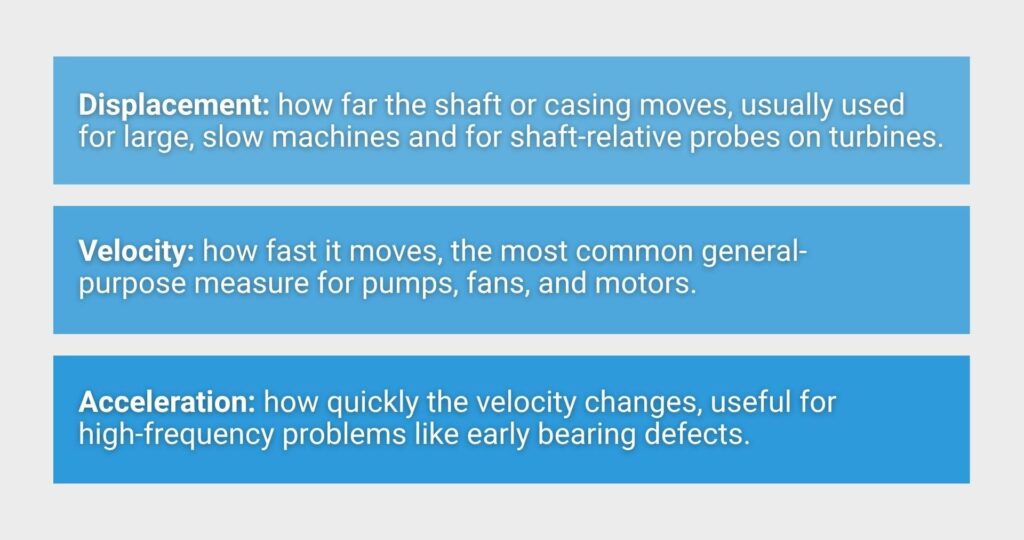
Frequency is how often the motion repeats. Engineers usually describe frequency as a multiple of running speed, because most faults show up at predictable multiples.
Analysis software uses a math technique called a fast Fourier transform (FFT) to split the overall vibration into individual frequencies. The result is a spectrum: a chart of amplitude at each frequency. Peaks in the spectrum point to specific sources.
Understanding 1x, 2x, and Other Harmonics
1x is vibration at running speed, once per revolution. A machine turning at 3,600 RPM has a 1x frequency of 60 Hz. Some 1x vibration is always present. A lot of vibration usually indicates something is heavier on one side than the other.
2x is vibration at twice the running speed. Elevated 2x often appears when two shafts aren’t lined up properly.
Harmonics are whole-number multiples of running speed: 1x, 2x, 3x, 4x, and so on. A long string of harmonics often means something has come loose. Non-synchronous frequencies don’t line up with running speed at all. They often come from rolling element bearings, which have their own defect frequencies based on their geometry.
These patterns are useful beyond handheld readings. Online monitoring systems can pull 1x and 2x amplitudes out of the raw vibration signal and feed them into equipment models as separate inputs. That gives the model a sharper view of what’s changing.
Common Vibration Signatures and What They Usually Mean
Here are the signatures most plant engineers learn first. Treat them as starting points, not verdicts. Real machines often show more than one at a time.
| Fault | Typical signature | Where you’ll often see it |
|---|---|---|
| Imbalance | Dominant 1x, mostly radial | Fans, pump impellers, rotors after repairs |
| Misalignment | High 2x, often with strong axial vibration | Couplings between motors, pumps, and gearboxes |
| Mechanical looseness | Many harmonics of running speed, sometimes half-orders | Loose bolts, worn fits, cracked bases |
| Rolling element bearing defects | Non-synchronous, higher-frequency peaks at bearing defect frequencies | Motors, fans, smaller pumps |
| Sleeve (journal) bearing problems | Sub-synchronous vibration, such as oil whirl below 1x | Steam turbines, large generators, boiler feed pumps |
These aren’t just rules of thumb. The DOE’s Operations & Maintenance Best Practices Guide lists the same conditions among the problems vibration analysis can find.
Vibration Analysis on Gas Turbines, Steam Turbines, Pumps, and Fans
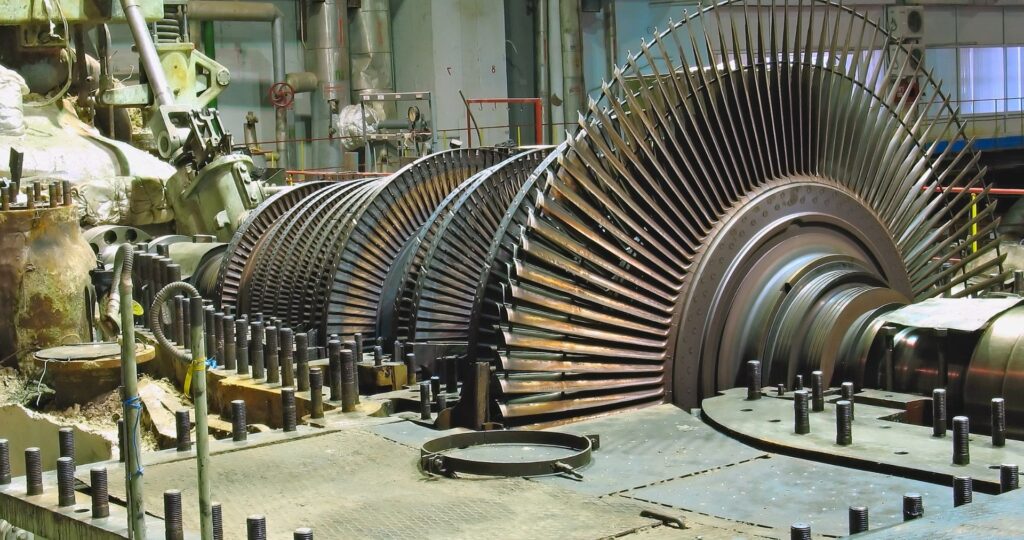
Vibration monitoring is one of the core tools of condition monitoring, and the basics are the same across a plant. What changes is what you watch most closely.
- Gas turbines: Proximity probes watch shaft motion in fluid-film bearings. Watch for changes in 1x amplitude and phase, and for vibration behavior while passing through critical speeds during startup.
- Steam turbines: Sleeve bearings dominate, so oil whirl and other sub-synchronous patterns matter. Bearing metal temperature belongs on the same screen as vibration.
- Boiler feed and cooling water pumps: Imbalance, misalignment, and bearing wear are all common. Pump vibration also rises when a pump runs far from its best efficiency point, which can look like a mechanical problem when it isn’t.
- Fans: Buildup on blades causes imbalance. Loose foundations and worn bearings show up as harmonics and non-synchronous peaks.
The same ideas carry over to heavy industry: kiln drives, mill fans, and paper machine rolls all follow the same physics.
What a Single Vibration Reading Can't Tell You
Here’s the limit of a single number: it doesn’t know what the machine is doing.
A pump vibrating at a certain level might be perfectly healthy at full flow and in trouble at half flow. A turbine bearing might read higher on a hot afternoon than on a cold morning, for reasons that have nothing to do with wear. Startups and coastdowns are different again, because the machine passes through critical speeds where vibration naturally peaks. The same thing applies to other transient data, as we explain in our look at combustion turbine startup data.
That’s why fixed alarm limits on vibration are a compromise. Set them tight, and they trip on normal changes in load. Set them loose, and a slow rise can stay under the limit for months. The U.S. Department of Energy says it is impossible to establish absolute vibration limits. Severity depends on the machine, its condition, and its history.
How Pattern Recognition Puts Vibration in Context
Advanced pattern recognition (APR) solves the context problem by judging vibration together with everything else the machine is doing.
Instead of one limit, an APR model learns how vibration normally moves with related tags. Those include load, bearing metal temperature, and lube oil temperature and pressure. Every scan, it predicts what vibration should be right now. It flags the machine only when the actual reading drifts away from that expectation.
That changes what you catch. Say a bearing’s temperature starts rising faster than load would explain. That can point to bearing wear or a lubrication problem, even while vibration and temperature both look “in range.” A vibration increase that tracks a load change gets ignored, because the model expects it. The result is earlier warnings and fewer false alarms.
FAQ
What problems can vibration analysis detect?
Vibration analysis can detect imbalance, misalignment, mechanical looseness, rolling element bearing defects, and sleeve bearing problems such as oil whirl. It can also reveal resonance, rubs, and some gear and coupling issues. Each problem tends to create a recognizable pattern at certain frequencies. That pattern helps engineers trace the vibration to its source before it causes a failure.
What is the difference between 1x and 2x vibration?
1x vibration happens once per shaft revolution, at running speed. 2x vibration happens twice per revolution, at double running speed. High 1x vibration most often points to imbalance, while elevated 2x vibration often points to misalignment, especially when axial vibration is also high. Engineers compare the two to narrow down the likely cause.
What is a normal vibration level for rotating equipment?
There is no single normal vibration level. ISO standards publish severity zones by machine type and size, and those are a useful starting point. The best baseline is the machine’s own history at each operating condition. The same reading can be healthy at full load and a warning sign at partial load.
How often should plant equipment vibration be checked?
Critical equipment like turbines, generators, and large boiler feed pumps is usually monitored continuously with permanent sensors. Less critical machines are often checked monthly or quarterly on a walk-around route. The right interval depends on how critical the machine is and how quickly its failures develop. It also depends on what continuous data is already in the plant historian.
Is vibration analysis enough to catch bearing failure early?
Vibration analysis catches many bearing problems early, but not all of them. Some sleeve bearing issues show up first as small changes in bearing metal temperature or lube oil conditions. Combining vibration with temperature, load, and oil data gives a more complete and earlier picture, and it helps rule out changes caused by normal operation.
Give Your Vibration Data Some Context
Vibration analysis is one of the most powerful tools a plant engineer has. Amplitude, frequency, 1x, 2x, and a handful of classic signatures will take you a long way. But a vibration reading alone can’t tell you whether a change is normal for today’s conditions.
That’s where context comes in. Models that understand load, temperature, and operating state earn their keep here. See how Predict-It monitors rotating equipment using the vibration data your plant already collects. If you have a question about a specific machine, talk to an engineer.